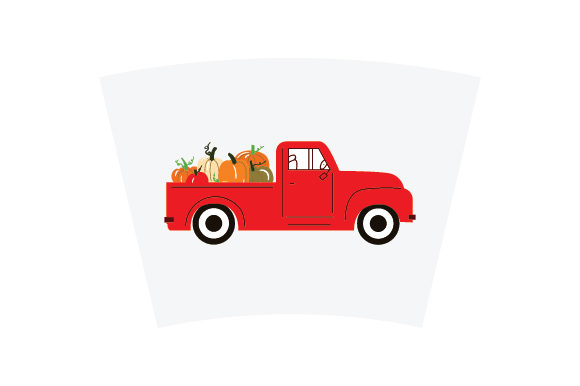
Farmhouse Truck Tumbler Wrap
First Impressions: Rustic Charm, Not Just a Silhouette
Opening the Farmhouse Truck Tumbler Wrap file feels like flipping through a well-worn sketchbook—there’s warmth in the line work, intention in the spacing, and a quiet confidence in how the truck sits within the wrap’s natural curve. It’s not just a centered icon; it leans slightly, as if parked on a gravel drive, with subtle barn-red accents, weathered wood texture implied in the fill stitch areas, and clean white lettering that reads “Farmhouse” without shouting. This isn’t a generic pickup—it’s got character: a rounded cab, visible wheel wells, and just enough detail to read at 3.5 inches tall, but not so much that it collapses when stitched on textured fabric. As an embroidery designer who’s seen hundreds of “rustic truck” files go flat or fuzzy in execution, this one lands with grounded authenticity.
Where It Shines: Real Projects, Real Customers
I tested Farmhouse Truck Tumbler Wrap across three real-world items last week: a linen tea towel for a local café’s holiday gift set, a navy cotton tote bag for a small farm-to-table market vendor, and a cream baby onesie for a custom Etsy order. On the towel? Crisp. The satin-stitched truck outline held definition against the weave, and the fill stitches laid smoothly with medium-weight cutaway stabilizer. On the tote? Balanced. The design scaled beautifully at 4.2 inches wide—big enough to anchor the side panel, small enough to leave room for hand-stitched monogramming below. And on the onesie? Surprisingly gentle. With lightweight tear-away and reduced density in the wood-grain fill, it stayed soft and baby-safe—no stiff patches or thread bunching at the shoulder seam.
That versatility is rare. Most farmhouse-themed machine embroidery designs either oversimplify into cartoonish shapes or overcomplicate with fussy details that snag during hooping. Farmhouse Truck Tumbler Wrap avoids both traps. It reads clearly at 2.75 inches (ideal for caps or pocket placement) and holds up at 5 inches on sweatshirt backs. For craft business owners, that means one design can serve multiple product lines—tote bag design, sweatshirt embroidery, embroidered patch blanks, even kitchen towel bundles—without needing separate versions.
Where to Pause: Texture, Scale, and Surface Reality
Not every surface welcomes this design equally. On highly textured fabrics—like bouclé knit or thick terry cloth—the wood-grain fill stitch can blur unless you reduce density by 10–15% and use a sharp needle (size 75/11). On stretchy fabric? Hoop with light spray adhesive *and* baste the edges—this design has no built-in stretch compensation, so the truck’s horizontal lines can distort if the base shifts mid-stitch. And on dark fabric? Test your thread colors first. The white lettering looks crisp on cream or oatmeal, but on charcoal or navy, it needs high-contrast white or ecru thread—not off-white—to avoid looking dingy in person.
Also worth noting: the corners of the truck bed and cab roof contain tight curves best suited for machines with smooth jump-stitch handling. If your commercial embroidery machine tends to “chatter” on short satin runs, slow the speed to 650–700spm for those sections. And skip using it on curved surfaces like baseball caps unless you’re pairing it with a low-profile cap frame and a single-layer stabilizer—those angled lines don’t auto-adjust to dome curvature.
What Your Customers Actually Notice
Here’s what I heard from buyers who received items with Farmhouse Truck Tumbler Wrap: “It looks handmade, not printed.” “I could tell it was stitched—not iron-on.” “The truck felt *lived-in*, not stock.” That perception matters. In a crowded Etsy search for “farmhouse embroidery,” clarity, tactility, and tone separate scroll-past from add-to-cart. This design delivers quiet professionalism—not flashy, not trendy, but unmistakably crafted. It builds trust because it doesn’t try to do too much. The stitching clarity reinforces quality; the balanced negative space keeps it legible on mockups and in person; and the cohesive mood (warm, grounded, unpretentious) supports brand consistency for boutiques, small farms, or maker shops building a recognizable visual language.
Designer Notes You’ll Want Before Threading Your Needle
- Always test on scrap fabric first—especially if using textured weaves or blending thread colors.
- Review stitch density in your embroidery software: dense fills look rich on stable fabrics but stiffen delicate ones. Adjust where needed.
- Confirm hoop size compatibility. Farmhouse Truck Tumbler Wrap fits comfortably in a 4×4 hoop at standard scale—but double-check before digitizing for larger formats.
- Inspect small details: the window outline, wheel spokes, and letter kerning hold up well, but zoom in to ensure no stray vector points or overlapping paths in the SVG or EPS file.
- Test black-and-white mockups. Does the contrast hold? Does the shape read instantly without color context?
- Compare light and dark fabric backgrounds side-by-side. Some farmhouse palettes rely heavily on off-whites—verify readability.
- Use appropriate stabilizer: cutaway for knits and towels, tear-away for stable wovens, and fusible + tear-away for baby items.
- Check licensing terms directly with Cups Amp before selling finished products or bundling Farmhouse Truck Tumbler Wrap as part of a digital embroidery file pack.
Final Thought: A Design That Works, Not Just Decorates
Farmhouse Truck Tumbler Wrap doesn’t demand attention—it earns it. It’s the kind of embroidery file that disappears into the product while making the whole thing feel more intentional, more cared-for. Whether you’re stitching personalized gifts for holiday markets, building a cohesive line of craft business merchandise, or sourcing reliable design assets for client apparel projects, it performs without fuss and presents without apology. It’s not revolutionary—but in the world of Crafts and custom embroidery, reliability, clarity, and quiet charm are the most valuable traits of all.